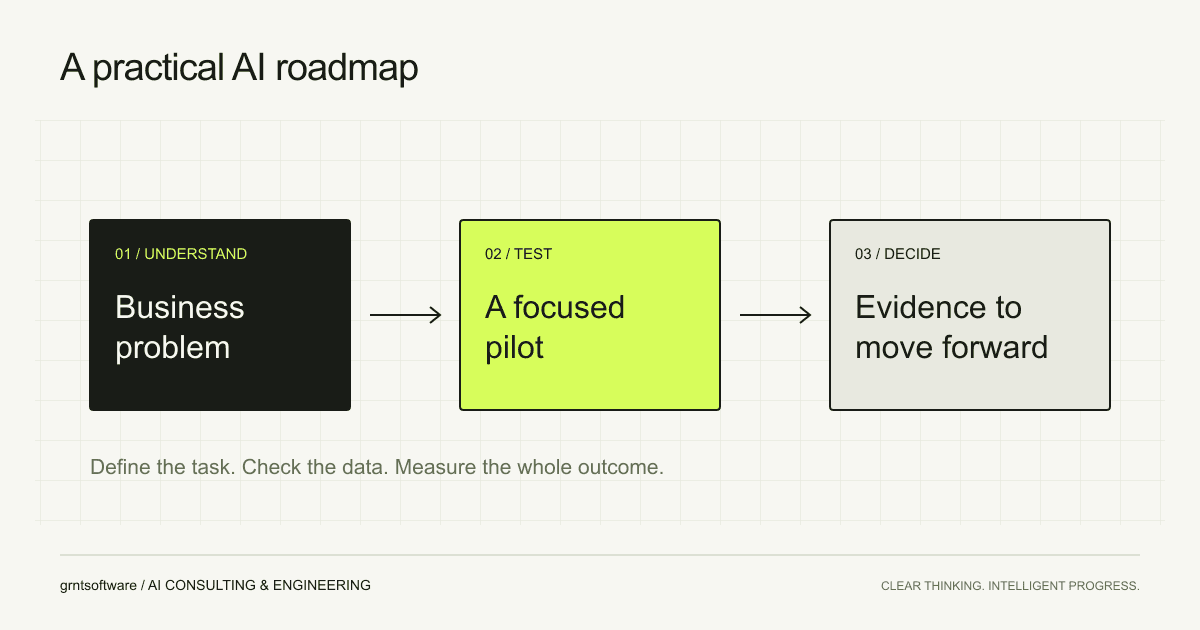
An AI roadmap should help a team make decisions. It should explain which problem to tackle first, what evidence is needed and what would justify taking the next step. A list of attractive tools is a starting point for research, but it does not answer those questions.
Key takeaways
- Start with a workflow and an accountable owner.
- Assess data access and quality before choosing an architecture.
- Agree on a baseline, an evaluation set and a decision point for the pilot.
1. Start with the work, not the model
Choose a process that people can describe in concrete terms. Who receives the request? Which systems do they open? Where do they make a judgement? What causes a delay or a handoff? Observe a few real examples with the people doing the work before writing a solution brief.
A useful problem statement includes the task, the user and the desired change. It gives the team something to test without prematurely committing to a chatbot, an agent or a particular vendor.
2. Check what information the system can use
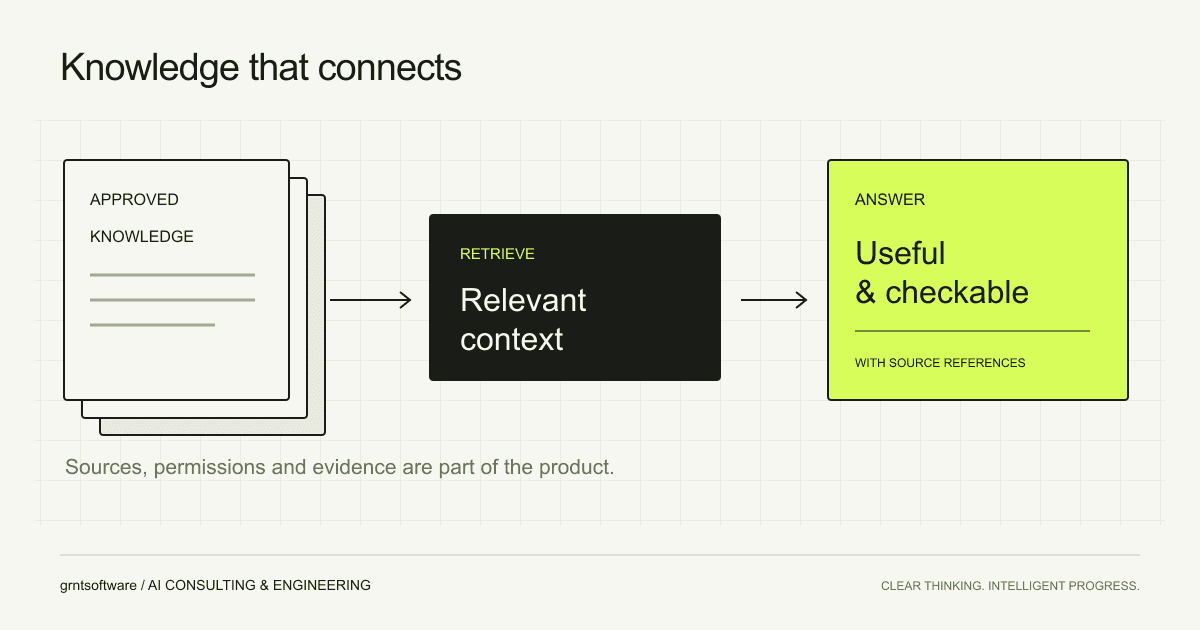
List the information needed for the task and identify its owner. Check whether it is current, consistently structured and accessible under the permissions the project will use. A file existing somewhere in the business does not make it ready for an application.
Include operational constraints in the same conversation. A pilot that depends on an unavailable integration or an unowned dataset can stall even when the model demonstration looks promising.
- Where does the source information live, and who maintains it?
- Which people may access it, and how are those permissions enforced?
- How will corrections, deletions and new versions reach the application?
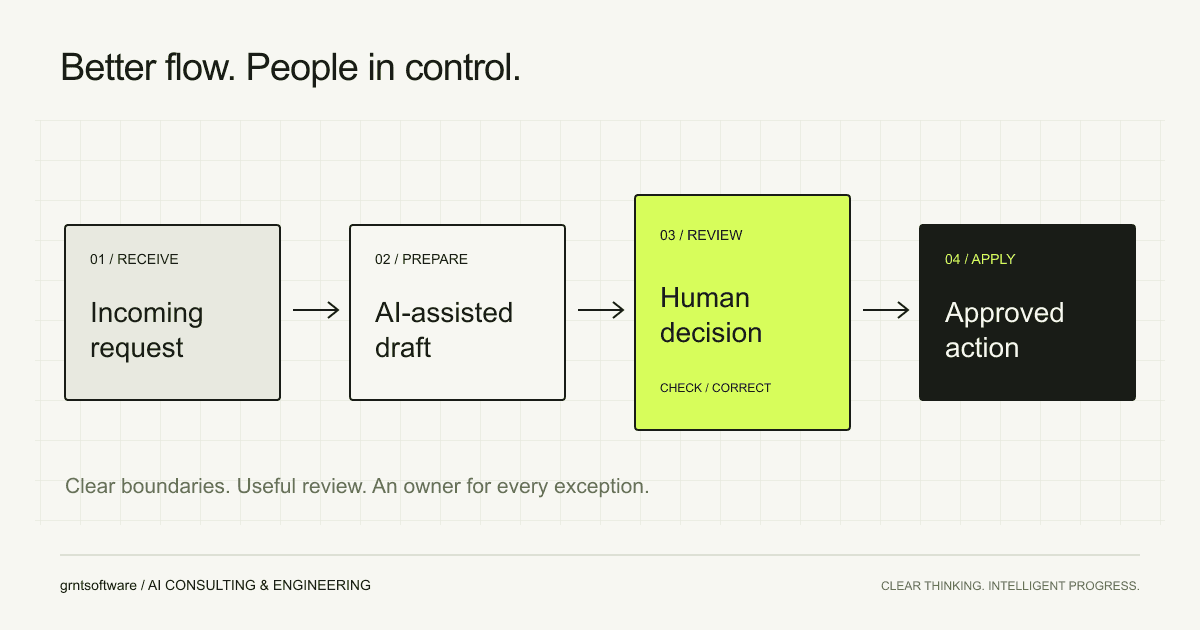
- Who handles an exception when the system cannot complete the task?
3. Compare opportunities using the same questions
Use a short assessment that makes tradeoffs visible. Discuss the value of an improvement, the readiness of the information and the difficulty of integrating a solution. Include the consequences of a wrong result rather than treating every use case as equally reversible.
| Question | Evidence to collect |
|---|---|
| Is the problem worth solving? | Task frequency, current effort and user feedback |
| Can we evaluate the output? | Representative examples and a named reviewer |
| Can we implement it? | Available data, permissions and integration access |
| Can we operate it? | An owner, an exception path and an operating budget |
4. Give the pilot a clear boundary
Specify the users, inputs and actions included in the pilot. State what it will not attempt. Build a small collection of representative cases, including incomplete inputs and situations in which the correct response is to ask for help.
Agree on the review process before comparing results. A faster first draft is only useful if the time spent checking and correcting it does not erase the benefit. Track the whole task, not just the model response time.
5. Plan the decision after the demonstration
Finish the pilot with a decision: expand it, revise the approach or stop. Document what the evidence supports, what remains uncertain and who owns the next stage. Include integration work, training, monitoring and ongoing maintenance in the next scope.
For a broader approach to identifying and managing AI risks, NIST’s AI Risk Management Framework offers an organisational reference. The working roadmap should translate relevant considerations into decisions and responsibilities for your specific project.